




Introduction
Water has always been important to mankind since the very beginning of history. We have seen the greatest and earliest civilisations, like those of Mesopotamia and Harappa, have flourished near the water bodies. Water plays a prominent role in the everyday life of a man. Thus, the need to settle around water is a primary thing to survive. Similarly to store water was also required to survive. History is already familiar with the kings leaving behind their palaces due to a lack of water. Fatehpur Sikri and Tughlaqabad are good examples. So to survive, many of the rulers have commissioned the making of Tanks, Wells, and Baolis, which later became the epitome of art and architecture of the city.
A Baoli is an ancient reservoir where early people used to store water. It was also the source of underground water. The water was mainly collected during the rainy season and then used throughout the year. Many members of the ruling class also commissioned Baolis to meet the need for water during scarcity. The water was used both for drinking and bathing. However, there were separate baolis for drinking and bathing. Baolis also became a shelter for travellers and caravans in need. But today, the very same baoli is lost in the busy urban lifestyle, and the conditions of these baolis have worsened.
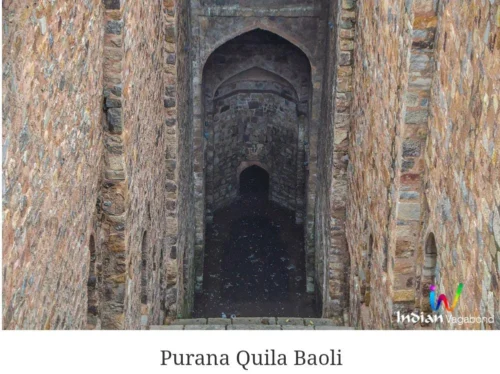
Origin of Baoli
The earliest origin of the Baoli can be traced back to between 200 and 400 AD, with structures like the Adi Kadi Vav in Junagadh. In Delhi, baoli can be found during the reign of Anangpal. He is credited with building the Anangtal Baoli in Mehrauli in the 10th century. Both the Tomars and Chauhans played an important role in establishing and expanding the Baolis in Delhi. With the growing population the demand to store water increased. The baoli stored the water during the rainy season and then the water was used throughout the year. After the Tomar and Chauhan the Delhi Sultanate continued to use Baoli especially the Mamluk, Khilji, and Tughlaq dynasties in an elaborate manner. This led to the establishment of Baolis in Delhi.
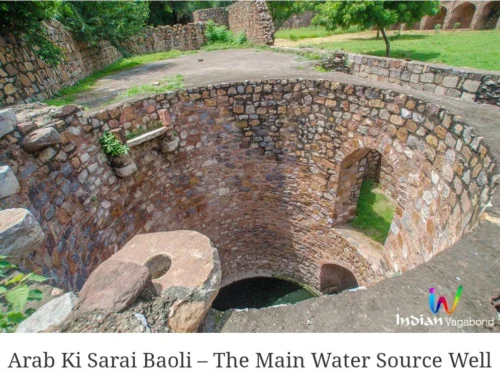
They refined the structure and built larger and more architecturally sophisticated baolis near forts, mosques, markets and caravan routes. Over time Baolis became an important part of Delhi’s water management system and a distinctive feature of its cultural landscape.A Baoli usually has three main components. The well in which the water is collected, the flight of steps to reach the groundwater through several stories, and intermediate pavilions. They help to collect the water from the baoli.
How it flourished
In Delhi due to the city’s chronic water scarcity and the constant need to support growing populations especially during the Sultanate and Mughal period expansion of baoli was required. As dynasties established new capitals in and around Delhi rulers, nobles, and Sufi saints commissioned baolis to ensure a dependable water supply for drinking, agriculture and travellers. The rocky Aravalli terrain made rainwater harvesting essential and baolis became an effective method to store monsoon water throughout the year. The construction of baolis also reflected a political and cultural priorities of the time providing public welfare, supporting settlements and showcasing architectural skill. As a result Delhi witnessed the rise of iconic baolis such as Agrasen ki Baoli, Gandhak ki Baoli, and Firoz Shah’s baolis, making them an integral part of the city’s historical water management system and contributing to the beauty of the city.
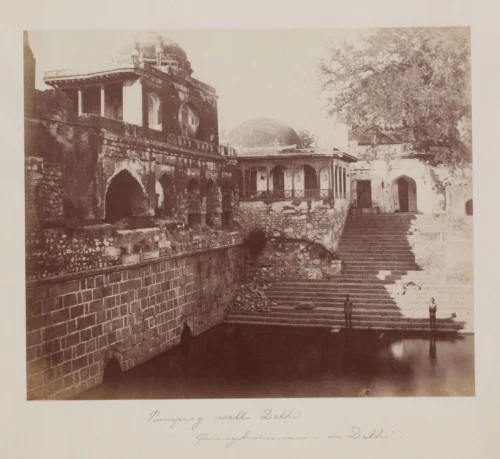
After the arrival of the East India Company, the Baolis lost their significance. The British mainly focused on the modern water system like building canals, pipelines, and modern engineering work which led to the decline of the traditional water system. The officials also considered Baolis unhygienic and outdated as many were neglected, dried up, or filled with debris. During the revolt of 1857, the Baolis became the place to hide. Their deep structure, dark chambers, and multiple levels made them ideal shelters where people could hide. It is also said that some fighters took refuge in Agrasen ki Baoli and Rajon ki Baoli using the stepwells as safe spots during British searches. Because of this the British authorities began to suspect baolis and even blocked access or drained them. This further added to the decline of baolis during Company rule as they were no longer just ignored but also viewed as potential hiding spaces for rebel.
Current Situation
Agrasen Ki Baoli was made popular through the Bollywood movie PK. Apart from that one may not be aware of any other Baoli of Delhi. It is believed that once Delhi had more than a thousand Baolis, but now only 13 are still present. To add on, none of the Baolis are functional today. The 13 Baolis include Tughlaqabad fort Baoli, Rajon ki Baoli, Gandhak ki Baoli, Anagpal Baoli, Red fort Baoli, Hindu Rao hospital Baoli, Dwarka Baoli, Feroz Shah Kotla Baoli, Arab ki Sarai Baoli, Hazrat Nizamuddin Baoli, Wazirpur Baoli, Purana Qila Baoli, and the most famous Agrasen ki Baoli. They are mostly used by young people to hang out or as a spot for people’s Instagram stories nowadays, and they stay relevant to the YouTube content creators who claim them to be haunted at night to gain views. Once, what was a basic need of the people is now just a casual spot for ”aesthetic photos”.
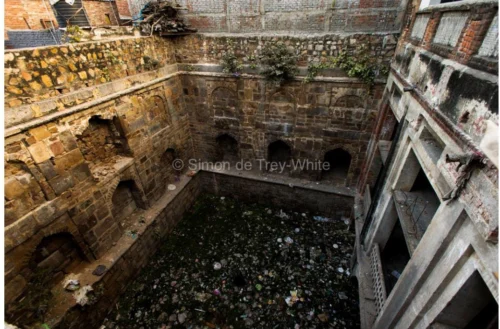
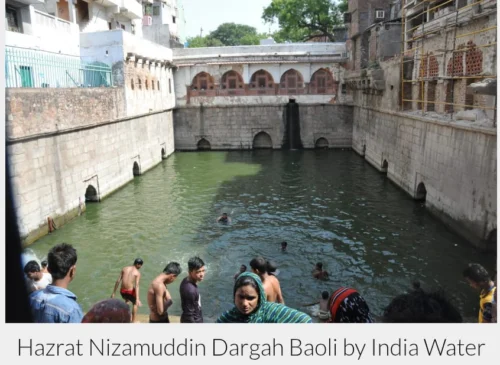
The water in many Baolis today can not be used for daily purpose. Algae and harmful bacteria float on the surface of water making the water unfit for any form of use. In several cases it is difficult to even recognise these structures as baoli due to neglect and encroachment. The water is severely contaminated and stagnant. Anangtal Baoli, which is the oldest Baoli of Delhi is located in a forest behind a neighbourhood and is used as a local waste dump and pig farm, with sewage running into it. It is so degraded that it is barely identifiable as a baoli today.It is now a dump area near the famous Dargah of Hazrat Khwaja Qutubuddin. Apart from that, there is another Baoli at Hazrat Nizzamuddin, which is fortunately maintained by the authority.
Nizamuddin Baoli
Built during the lifetime of Hazrat Nizamuddin Auliya in the years 1321-22, this is the only Baoli in Delhi that still has underground springs. In July 2008, portions of the Baoli collapsed and after exhaustive scientific analysis and consultation with the community conservation works to rebuild the collapsed portion commenced. The Baoli was de-silted to its original depth of 80 feet below the ground level and major repairs including the removal of the 20th-century epoxy layer, were carried out. The collapsed portion was restored with traditional materials by master craftsmen working under the close supervision of structural engineers and architects who utilised state-of-the-art equipment to monitor the works.
There is also a very famous story behind the history of the Nizamuddin Baoli. During the construction the then-contemporary ruler Ghiyas-ud-Din ordered all the workers of the baoli to leave their work and to work for his glorious capital, Tughlaqabad. To this, Hazrat Nizamuddin requested the labourers to build the baoli at night, after their work for the Sultan was done. When Ghiyasuddin found out about it the ruler clamped down on the sale of lamp oil so that no one could work at night. The saint cursed the fort of Tughlaqabad, which was soon abandoned for lack of water, and instructed that the lamps around the baoli be lit with water. It worked, and the stepwell was finally built. Ever since, Nizamuddin Baoli has been a mainstay for pilgrims who consider its waters to have miraculous properties.
Conclusion
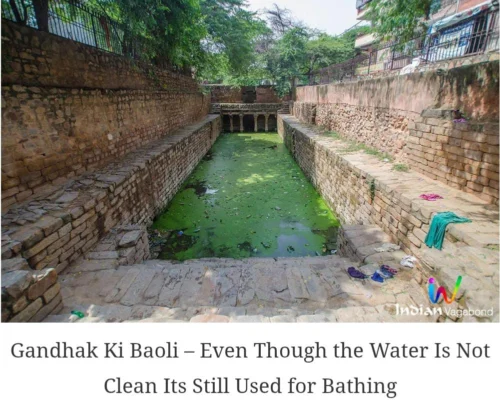
Today the baolis have become a place for young people to go around for fun. None of them truly know the importance it had in Medieval times. One can find dead birds, small animals, used clothes, scraps of people, and lots of rubbish scattered all around. Today despite all restoration efforts of government bodies and even private entities like INTACH many of them are unusable. Baolis have now become a place to dump the garbage. Gandhak ki Baoli, which is shown in the picture has truly lost its significance. People have thrown used clothes and spit around the baolis. Due to stagnant water bacteria are growing. The water can not be used for domestic chores. This is the condition of the majority of the baolis in Delhi. The government has taken barely any action to preserve and conserve the baolis .It is truly unfortunate that baolis have become a lost heritage. What once sustained Delhi’s people and empires is today reduced to ruins buried under waste and indifference. The survival of baolis now depends on our willingness to value, protect, and revive them before they become nothing more than memories.
References
-
Madiha, A. (n.d.). Tracing the water conservation heritage: A case of baoli in Delhi. Medium.
https://medium.com/@madiha.arch20/tracing-the-water-conservation-heritage-a-case-of-baoli-in-delhi-e40c5d30d58a -
Indian National Trust for Art and Cultural Heritage. (n.d.). Baolis of Delhi. Google Arts & Culture.
https://artsandculture.google.com/story/baolis-of-delhi-indian-national-trust-for-art-and-cultural-heritage/8gVRBQUicQcA8A -
Speaking Archaeologically. (n.d.). The Baolis of Delhi project.
https://speakingarchaeologically.co.in/the-baolis-of-delhi-project/ -
Negotiating water: Baolis of Delhi—A historical perspective. (n.d.). Academia.edu.
https://www.academia.edu/44516069/Negotiating_water_Baolis_of_Delhi_A_Historical_Perspective -
Sarmaya. (n.d.). Stepping into the underground splendour of Delhi’s baolis.
https://sarmaya.in/reads/stepping-into-the-underground-splendour-of-delhis-baolis/
Keep coming with articles ✨🪄
Wonderful and insightful ✨