
1. Introduction
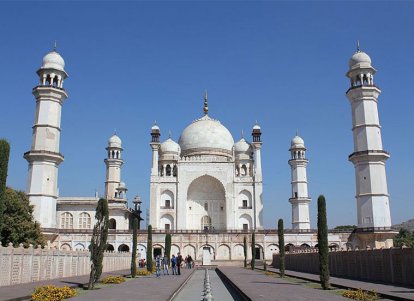
Nestled in the vicinity of Sambhaji Nagar in Maharashtra there is a spectacle of Mughal architecture, popularised by its misnomer ‘Taj of the Deccan.’ This grandeur is Bibi-ka Maqbara or ‘Tomb Of The Lady’, constructed as a tomb of Rabia Durani, wife of the sixth regnal Mughal emperor Aurangzeb. This monument, as a result of being subject to myriad contrasts with the Taj Mahal of Agra, is often reduced to obscurity and even desolation—popularly and historiographically. According to Sylvia Crowe and Sheila Haywood, the mausoleum “appears to have been based on the design of the Taj Mahal. The concept is the same […] however […] splendour and utter certainty […] are replaced by a confusion of elements and a weakness of proportion which show clearly that […] the inevitable decline had set in.” Similar standard views are upheld by Z.A. Desai, J. Brooks, and many more who regard the Bibi ka Maqbara, in simplistic terms, as a blatant and substandard ‘copy’ of the Taj.

However, a keen silver lining can be observed in recent scholarship like those of Catherine Asher giving the exclusivity the structure heavily yearns for, the fact that Bibi-ka Maqbara ‘is different in notable ways.’ Therefore, the Bibi-ka Maqbara ought to be viewed objectively.
2. Historical Threads
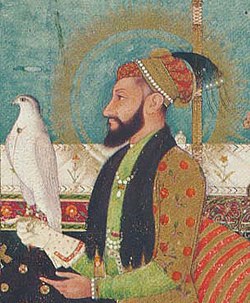
The Deccan had been under the reigns of Aurangzeb during the middle of the 17th century. Hence, when Aurangzeb’s wife Rabia Daurani passed away in 1657, it provided for a good pretext for the father-and-son duo i.e. Aurangzeb and Prince Azam Shah to symbolise their power in the Deccan, and holistically over the empire. The fact that Aurangabad was chosen as the site for erection of the tomb was strategic, since this was the location where his headquarters were at as ‘princely court.’ Naming the city, which was re-founded by Aurangzeb, as Aurangabad also reflected a common Mughal practice since Shah Jahan (when he was referred as Prince Khurram) also founded Khurramabad between Sasaram and Varanasi.

In the years 1656 and 1657, Aurangzeb occupied parts of the Bijapur kingdom after the death of sultan Muhammad Adil Shah. Both Dara Shokoh, who was the chosen heir for the throne, and Shah Jahan ordered Aurangzeb to withdraw his attempts in the Deccan. As stated by J. F. Richards, “A peremptory order from the emperor left Aurangzeb, despite his protests, to withdraw.” Despite being subject of prejudice and labeled as a ‘bigoted fanatic’, Aurangzeb had intricate knowledge of Golconda and Bijapur architecture style, which was indisputedly applied by his son Azam Shah, the patron of the tomb for his mother. According to Catherine Asher, the Bibi-ka Maqbara is ‘Approximately half the size of the Taj Mahal’—a huge achievement.
3. Nitty-Gritties of Construction in 17th Century
On the main entrance to the mausoleum, an inscription states that the structure was both designed and constructed by architect Ata-ullah and engineer Hanspat Rai. Interestingly, Ata-ullah was himself the offspring of Ustad Ahmad Lahauri, who was the primary designer of the Taj Mahal. The construction of Bibi Ka Maqbara is said to have taken place between 1668 and 1669 C.E.—however, accounts vary. As noted in the text ‘Tarikh Namah’ by Ghulam Mustafa, the total expenditure for the mausoleum’s construction work amounted to 6,68,203 rupees and 7 annas, while Aurangzeb allocated a budget of only Rs. 7,00,000 for the rigorous work. The marble used for the mausoleum was sourced from mines close to Jaipur. The French traveler Tavernier during his journey from Surat to Golconda observed approximately three hundred carts carrying marble, each pulled by a minimum of 12 oxen.
4. Architectural Intricacies of Bibi-ka Maqbara
4.1 General Arrangement

The tomb of the queen has a large complex, incorporating a Char-bagh, which literally means a four-quartered garden. Additionally, there is a central mausoleum, and four buildings minor in scale. This layout is similar to Humayun’s Tomb in Delhi, and becomes a standard Mughal architecture scheme.
4.2 Grand Entrance and Enclosure Walls

The entry is at the southern part of the mausoleum, with its exterior covered by wood. The wood incorporates Brass plates with myriad motifs and designs. The Bibi-ka Maqbara is built by a central structure surrounded by an enclosed wall of 458 m by 275 m dimensions. The wall features pillared pavilions, commonly referred to as baradaris. These are located in the eastern, northern, and western sections. It contains arched recesses separated by pilasters or columns for support. These recesses include small minarets. In addition to the recesses, there are bastions, both of which are constructed at regular intervals. The wall is constructed on a square foundation, with a minaret positioned at each corner of the platform.
4.3 Mausoleum and Mortuary Chamber

The mausoleum was constructed using marble up to the lower section of the wall called: dado level. Above this level, basalt was utilized for the building until reaching the dome, which was also made of marble. The basalt here is layered for a smooth look and adorned with stucco. The tomb of Dilras Banu Begum, posthumously popularised as Rabia Durani, is located in a chamber beneath ground level, accessible through a staircase. The tomb chamber contains a flat gravestone, rather than a raised cenotaph, covered with a silk fabric, a metaphor for respect for Rabia Durrani. Its unadorned nature, along with the chamber’s thoughtfully designed ventilation system likely intended to evoke the openness recommended in orthodox Islamic burials, highlights the religious characteristic of Aurangzeb and his cohort’s beliefs.
4.4 The Mosque

Like every other aspect, the mosque at Bibi-ka Maqbara is compared with Taj’s imperial mosque. According to Laura E. Parodi, mosque at Taj Mahal is a Mughalized version of a ‘typical Lodi funerary mosque.’ The three domes, which was a characteristic Lodi feature, became a standard in Mughal architecture. However, in Bibi’s complex, neither of the two mosques has any domes. There were various inspirational structures to the architect, as there were many flat-roofed Deccan mosques and the mosque built by Shah Jahan in the premises of Dargah of Muinuddin Chishti in Ajmer in 1628. In the latter, cupolas are absent which meant to show subordination of the mosque to imperial authority. Parodi exclaims that despite Aurangzeb’s religious fanaticism, this was the intention behind Rabia’s tomb as well.
5. Niche Embellishments: Bijapuri and Mughal Synthesis

The entire architecture of the Tomb is quite inherent to its surrounding Bijapuri connotations, as Catherine Asher interprets, “An emphasis on the building’s verticality, not the harmonious balance of proportions as at the Taj.” At Bibi-ka Maqbara, just like Ibrahim Rawza’s tall minarets, there are minarets taller than the central edifice. As Parodi elaborates, in the corner turrets there is the pishtaq-and-dome combination with an equally vertical accent—a Bijapuri influence. The arches of Bibi-ka Maqbara are especially fascinating since multicusped arches are characterized by Adil Shahi architecture in Bijapur. Herein, there are 25 cusps, similar to Bijapuri trends—as opposed to 13 or 16. C. Asher points out, in a footnote by Parodi, that cusped arches will become more popularised in Mughal architecture—a testimony to mixing trends.

The minarets of Bibi-ka Maqbara appear to be the same as Taj’s minarets, however the latter’s are cylindrical shafts with a ‘Timurid’ touch, and the former’s are octagonal. The Maqbara is covered in palmettes, which is another Deccan touch, since the Golconda Fort mosque is identified with similar palmettes. The octagonal section of the minars provides both the Ibrahim Rawza and the Bibi-ka Maqbara their remarkable plasticity, as opposed to the ‘immaterial quality of their smooth Taj counterparts.’
6. Symbolic Motifs on the Maqbara

The motifs in the Maqbara are a reference to Paradise from Persian poetry. The largest sections of the paintings are found in the western mosque, while the southern gate also features red and green painted accents on its façade arches and interiors, whose lavish appearance derives from the complexity of the stucco relief designs beneath rather than the colors themselves. Additionally, the northern pavilion boasts mural decorations depicting cypress trees and wine vessels that resemble those on the walls of the gateway.The Stucco covered buildings are recurring decorative items used in Deccani edifices. The relief stucco work includes floral plants, detailed arabesques, and elaborate floral patterns bordered by curved lines that create alternating medallions.
7. Conclusion: Preservation and Significance

The Bibi ka Maqbara, as journalist Prasad Joshi reports, is suffering from neglect and constant damage. The Archaeological Survey of India has provided preservation arrangements to support the damaged wall near the fountain, however, their approach and systemic neglect must be improved. Architect Ajay Kulkarni mentions that if the monument doesn’t face rapid conservation, then it will go through irretrievable demolition. In 2020, a decent budget was amassed for conserving the domes of Bibi-ka Maqbara. Moreover, in 2024, near a hill close to the Maqbara, some earthenware was found, possibly dating back to the construction time. These instances reflect the dire need to protect, preserve, and conserve the monument from communal divide and conflicts.
References:
Bibi Ka MaqbaraBibi Ka Maqbara. (n.d.). MUGHAL LIBRARY. https://www.mughallibrary.com/images-1/bibi-ka-maqbara
Bibi ka Maqbara: The Timeless symbol of love in Aurangabad. (2025, March 24). Moneycontrol. https://www.moneycontrol.com/travel/bibi-ka-maqbara-the-timeless-symbol-of-love-in-aurangabad-article-12973746.html
Bhagat, M. (2025, February 3). Bibi ka Maqbara: The ‘Mini Taj Mahal’ That’s a love story in its own right. Times Now. https://www.timesnownews.com/travel/destinations/bibi-ka-maqbara-the-mini-taj-mahal-thats-a-love-story-in-its-own-right-article-117880697
Joshi, P. (2025, April 29). Bibi ka Maqbara languishes in neglect, outcry grows for urgent upkeep and restoration of heritage site and tourist hub. The Times of India. https://share.google/tNeGppll5dfh6H3UI
Pti. (2020, January 6). Marble domes of Aurangabad’s Bibi Ka Maqbara to get new glow. The Hindu. https://share.google/7AznJnJzOoroSeXzs
Desk, L. E. (2024, February 28). Earthenware unearthed during excavation at Bibi-Ka-Maqbara to be studied. Lokmat Times. https://www.lokmattimes.com/aurangabad/earthenware-unearthed-during-excavation-at-bibi-ka-maqbara-to-be-studied