
Introduction:

Karagattam is a traditional folk dance of Tamil Nadu that has its roots in tribute to the rain goddess Mariamman. It is divided into four types: Thondi Karagattam, Agni Karagattam, Adukku Karagattam, and Poo Karagattam. The dance performed by a group of three to five dancers, this art form is popular among the rural communities of Tamil Nadu. It is presented during both secular and religious celebrations. A typical Karagattam troupe commonly consists of two male dancers, a buffoon, and two female dancers, who are sometimes replaced by transgender performers. They are accompanied by a musical team popularly known as the Nayandi Melam. A unique feature of this art form is the balancing of pots on the head by the female dancers. In fact, the etymology of the word Karagattam originates from the Tamil words “Karagam”, meaning pot and “Aattam”, meaning dance.
Origin:
Initial evidence of the art form is found in the Sangam epics. In the Nalayirithu Divyaprabandham, Lord Krishna is referred to as “Kudamadu Koothan,” implying that he danced with a pot on His head. A reference to the dance form is also found in the Silappadikaram. However, there is no proof to suggest that the Karagattam we see is similar to the one we see or described in the Silappadikaram,
Karagattam in the rural parts of South India was performed by villagers during the Tamil month of July and August, a time when the regions receive the monsoon rains. Karagattam usually comprises a lot of physical skills that includes acrobatic elements such as stilt walking and human pyramid formations, which are often part of the dance, enhancing its visual appeal and attracting the audience.
According to a different theory, the dance is believed to have originated during the rule of the Chola dynasty. Some historical sources believe that, it was performed by women of the royal household to entertain the king and queen, particularly during the month of December, the Tamil month margazhi. However, while the origins of Karagattam vary from one source to other, the exact history about the art form remains indefinite and ambiguous to this day.
Performance and procedure:

The performance always begins with the dancer offering prayers first to the deity, then to the guru (teacher), and finally to the audience who have gathered to witness the performance.
The dance opens with a “Mookkayi Vesham,” where an elderly female takes the centre of the stage. She introduces the theme and concept of the performance through clever sayings and proverbs. What makes this segment special is that the makeup and gestures are specific to the region, reflecting the flexibility and the adaptive style of the art form.
The next segment follows the Kuravan-Kurathi Aattam (which particularly refers to the tribal community in the Kurunji region of Tamil Nadu). This performance engages with the audience and tries to make them aware and impart a sense of consciousness in them. The particular act is more of a social commentary that highlights political scenarios, social issues, and regional affairs in a dramatic narrative that makes people both enjoy and think.
This is followed by the Nalla Thangaal Kathai. The main aim of this this part of the performance is to connect with the audience. It tells the story of the ordinary people, the people of the region, their history, livelihood, struggles, and joy. This is the most carefree and cheerful segment, primarily performed to resonate with the local audience. Next comes the Poi Attam. In this segment, the artists perform with highly animated expressions and, at times, even enter a trance-like state. This creates an atmosphere filled with devotion, attracting and pulling the audience completely into the performance on stage. Finally, the act comes to an end with Manglam. Where the artists thank the audience, the teacher and God.
The Karagam

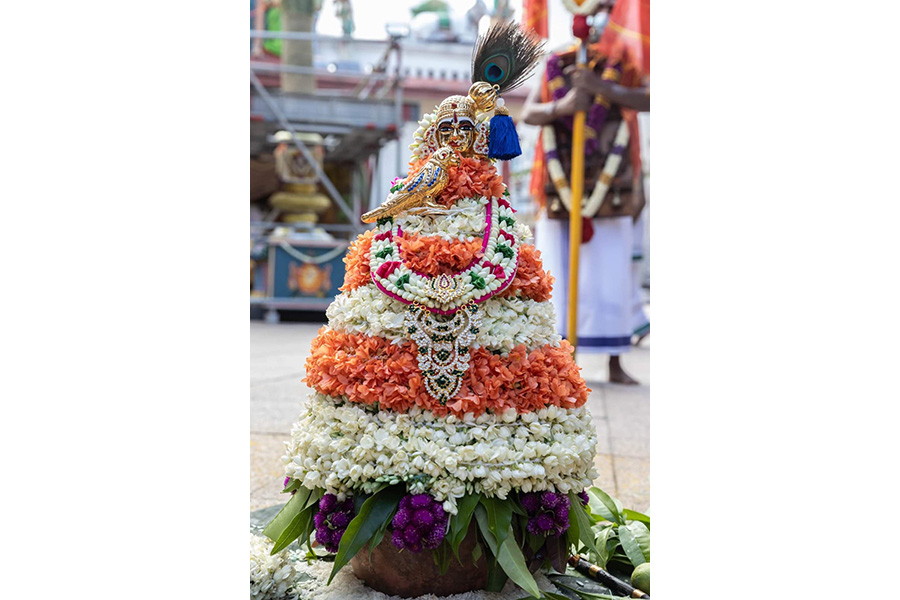
The Karagam (pot) is the most important and significant object in the performance. It is decorated in a grand and intricate manner that includes multiple layers and detailed symbols. Believed to symbolise the Hindu goddess Mariamman, the Karagam[pot] is primarily filled with water and sacred objects. The outer layer of the Karagam is decorated with neem leaves and jasmine garlands, held together by a cotton thread. Despite these decorations, performers ensure that a significant portion of the pot remains visible, show the very essence of the art form. The inside of the pot is filled with rice and water, with the quantities varying from one pot to another.
Over the years, the aesthetics of the Karagam have evolved from a simple pot filled with leaves and flowers to a pot designed with gemstones and various ornaments. At the top of the pot stands a vibrant and beautifully crafted parrot, this adds a unique touch as well as adds to the visual appeal of the performance.
Current status

Traditionally, women who perform Karagattam have often faced the wrath of patriarchy, with society labelling them as prostitutes. Unfortunately, the current scenario is not very different from these age-old prejudices, as attitudes of the people continue to offer little or no justice to these performers. Their financial struggles and caste backgrounds further add to their already existing challenges, making it even harder for them to speak out against the systemic violence and daily discrimination they continue to endure. Karagattam, on the one hand, is celebrated by the state government and celebrated as the region’s cultural identity, while on the other hand, the artists suffer at the hands of the power politics and dynamics caught in the web of desire and exploitative hegemony.
Conclusion
Karagattam overall requires exceptional concentration, focus, hard work, dedication, and practice. The dancers involved often devote themselves to the art completely and willingly, making personal and professional sacrifices. But according to the artists, more than the physical demands, it is the social and emotional constraints that have become the greatest challenges to the growth of this art form. While many artists struggle financially, society further burdens them with ingrained superstitions, stripping them of the recognition they deserve. This only adds to the growing list of hardships the performers face. Despite the eagerness among the volunteers who wish to carry it forward, without proper measures to ensure the safety and dignity of the performers, this art form is destined for a sad end. Despite the eagerness among the volunteers who wish to carry it forward.

References:
Diamond, Sarah Louise. Karagattam: Performance and the Politics of Desire in Tamil Nadu, India. PhD diss., University of Pennsylvania, 1999. ProQuest Dissertations & Theses Global (Publication No. 9937718).
Dharmalingam, B., et al. “Dance Form of Karagattam – The Regional Folk Dance in Tamil Nadu.” Shanlax International Journal of Arts, Science and Humanities 7, no. 1 (2019): 71–75.