
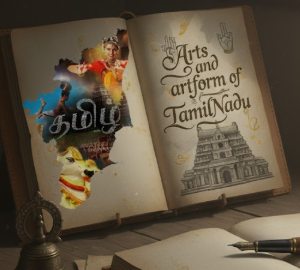


Thanjavur Paintings
Introduction:
Have you ever heard of a small town named Thanjavur in Tamil Nadu? If not, now is the time to get enlightened about the town’s one of the famous art forms – The Thanjavur Paintings. Starting from ancient days, drawings have been a part of our life. Initially used for communication, they have evolved into a way of expressing our feelings. The paintings speak of the cultures and heritages of their respective motherlands. These Thanjavur paintings speak of the glorious days of artists who were nurtured with the talent of drawing on wood – reflecting their beliefs in Hindu deities, Jainism, Sikhism, and also Islam. These paintings act as a secularized art form.

In today’s world where oil, water colour, and gouache paintings dominate, Thanjavur painting is known for its old-school style. The art form is done on wood with spraying the gold over the paintings, which gives them a glittering-divine outlook. This art form has its root from the 16th century and is still thriving after surviving the reigns of Marathas, Nayakas and even the British.
Origin of the Art Form:
The Early Stage:
Vijayanagara Empire was mainly ruled by Nayakas. They lost their empire to Deccan Sultanates in the Battle of Talikota(1565). This caused many painters to migrate towards Thanjavur looking for new patrons. It was during Achyutappa’s reign that the Vijayanagara Empire fell, leading to a migration of artists, musicians, philosophers, and writers to Thanjavur and other neighbouring regions.

As the Thanjavur Nayakas were the third biggest Nayaka empire in Tamil Nadu, artists migrated from Vijayanagara Empire fearing that their arts wouldn’t be praised by the capturers of their native places. Thus, the famous art of ‘Thanjavur Paintings’ was born. The artists had their styles, and when Nayakas were later defeated by Marathas, they added their cultural touch to the paintings.
Marathas:
The art form which began under Nayakas’ rule attained its highest flourishing stage under Marathas – especially under Serfoji-II. The art form was initially known as ‘Palagai Padam’. “Palagai” meaning “wood” and “Padam” meaning “image,” literally “painting on wood.” Serfoji supported the artists by encouraging and patronising them. Serfoji was fighting the British on one side, yet he continued supporting the artists throughout his reign.

During his reign, artists started experimenting with different materials and styles – from painting on canvas, glass, and paper, to even creating miniature ivory portraits known as Rajaharam, which were worn as pendants.

The artists were inspired by Chinese reverse glass painting, and they started painting on the back of a glass sheet, added gold and metal to make it sparkle like jewellery. This mix of Indian and Chinese tradition gave Thanjavur paintings their signature appearance and fame. The art form reached its peak here.
But when Rajah Serfoji lost his rule, the Chettiyar community took over this art. Being devotees of Lord Shiva, they mainly portrayed lots of Shiva images in their arts. One of their monasteries in ‘Koviloor’ has large Thanjavur paintings on the lives of the 63 Nayanmars (Saivaite saints). The art form from then has been continuously thriving and even after 400 years these paintings are still a treat for the eyes.
Details About the Motifs:
How the Painting Was Made:
The process of making a Thanjavur painting begins with a wooden plank (either jackfruit or teak) covered with a canvas using Arabic gum. A paste made from chalk powder or limestone was made and it was bound and spread over the wood. It was left out to dry. Then the artist would sketch the outline of his desired painting using a stencil.
For the raised parts (known as gesso work), a paste of limestone powder and a binding medium called sukkan or makku was applied. Then came the highlight – 24-carat gold leaves and gem inlays on specific areas like arches, pillars, and ornaments. Finally, the painting was coloured using vibrant natural dyes.
The figures were arranged on a single plane in a balanced, patterned composition – a style influenced by Deccani paintings and Islamic art. The result was a stunning blend of Tamil, Maratha, Deccani, and even Chinese artistic elements.

Thanjavur paintings are specially known for their bright colours, their iconic composition, use of gold foils, and 3D gesso work. Glass beads, semi-precious stones, threads and laces were used to increase the painting’s beauty and texture.
In order to highlight jewellery, crowns or backgrounds, artists used a thin 24 carat gold foil. These make the art glitter. The rest of the art is filled with bold red, green or yellow colours. Because of the high-quality gold, these paintings last for a longer time.

The main subjects are Hindu deities and stories from the Puranas, but over time, Jain, Sikh, Muslim, and secular themes also appeared – showing the secular nature of this traditional art form. The unique gold foil technique remains its signature touch, even in modern adaptations on mirrors, glass, and canvas.
Relations:
Thanjavur’s art has been found to have similarities with many art forms. Some of them include Vijayanagara murals and gilded Deccan paintings.
Vijayanagara Murals:
Jaya Appasami, an artist and critic has noted strong similarities between Thanjavur paintings and Vijayanagara murals in the Virupaksha Temple of Hampi. These murals were found to be divided into panels with arched frames featuring deities. It almost looked like early prototypes of Thanjavur paintings.

Gilded Deccani Paintings:
The Deccani style may look different at first glance, but it shares common traits of surface textures, symbolic architecture and a love for gold decoration. The “gilded” look, luxurious colours, and religious subjects – these three are the core elements of Thanjavur paintings which we know today.

Recent Scenarios:
Thanjavur paintings are still made today, though the traditional rigor has slightly faded. The natural dyes have been replaced by acrylics. The types of wood used and the patterns have evolved over the years. To preserve this art form, the government and private groups take measures by conducting workshops, exhibitions, and even training programs.
Modern changes include:
• Materials: Plywood replaces jackfruit or teak wood.
• Colours and Adhesives: Synthetic ones are cheaper and easier to find. Acrylics are used instead of natural dyes.
• 3D Effect: Artists use muck powder (chalk) for raised detailing.
• Subjects: From gods and saints to modern celebrities and abstract themes.
While commercialization has affected the quality, the art continues to attract new generations. Many artists mix the Thanjavur style with modern media, creating pieces on mirrors, glass, and canvas – but keeping the signature gold foil as the centerpiece.

References to Pop Culture:
Even in today’s digital world, Thanjavur paintings continue to shine in books and museums.
Art historians like Anna L. Dallapiccola, along with Kuldeep Singh and R.G. Singh, have written a detailed book titled “Thanjavur’s Gilded Gods.” This work explores every aspect of the art – from its design, colours, and use of gold leaf to its preservation and cultural meaning. The book is considered a treasure for anyone studying Indian art heritage.

These arts can be found in Thanjavur Art Gallery inside the Thanjavur Palace, the Government Museum in Chennai. Apart from Indian museums, Thanjavur paintings can be found even in museums of London’s Victoria and Albert Museum.

In pop culture, their influence is everywhere – from calendar art in South Indian homes to modern digital prints inspired by their colour palette and symmetry. Famous South Indian artists like C. Kondiah Raju has adapted the Thanjavur style for calendar prints. He gave iconic visuals of gods and goddesses. Even in cinema, Thanjavur-arts appear in scenes that highlight tradition and devotion. The deity patterns used in these paintings are also used by modern fashion designers.

Even in cinema, Thanjavur-style backdrops appear in scenes that highlight tradition and devotion. Some modern fashion designers also borrow motifs from these paintings, incorporating the rich gold and deity patterns into fabrics and jewellery design.
Conclusion:
Even though the reigns of Marathas and Nayakas have fallen down, the paintings continue to flourish. This is a symbol of South Indian culture. By recognizing its heritage value and aiming at protecting the art, Thanjavur Painting has been granted a Geographical Indication (GI) tag in 2007–2008 by the Government of India.

Today, artists blend their old techniques with new ideas. Tradition and technology have been merged by them in the paintings. Whether displayed in a temple, museum, or modern home, a Thanjavur painting still glows with the same divine warmth it carried centuries ago.
Even though the government takes huge steps for preserving traditional art forms, apart from them, only if we as people become enlightened, support the families who do this artwork, make it famous across all art enthusiasts, the art will be preserved.
As time evolves, the artists and the art forms also evolve. But the soul of the art remains the same forever. These paintings are not just an art form – these are the history which speaks culture, heritage and craftsmanship. May it bloom forever.
References:
- http://memeraki.com/blogs/posts/the-evolution-of-thanjavur-paintings-a-cultural-synthesis-of-indian-art-and-heritage?srsltid=AfmBOopGpshZJ3tNPc209sp_ZHENAhd5RXwCJz9z-DGEpzlsYlElWnrS
- https://en.wikipedia.org/wiki/Thanjavur_painting
- https://www.artisera.com/blogs/expressions/tanjore-painting?srsltid=AfmBOorZ-c1djgu2C5bi-WaZYWmnMVaXmi70xbikYvpAfOuG58epNN1D
- https://www.ibpbooks.in/thanjavurs-gilded-gods-south-indian-paintings-in-the-kuldip-singh-collection/p/33558
- https://www.exoticindiaart.com/article/world-of-tanjore-paintings/?srsltid=AfmBOooxB92p776Pab80yWoEKCxHPONqxGXqnPrlpo3Wu8_ebBwSWO_Y