
Introduction

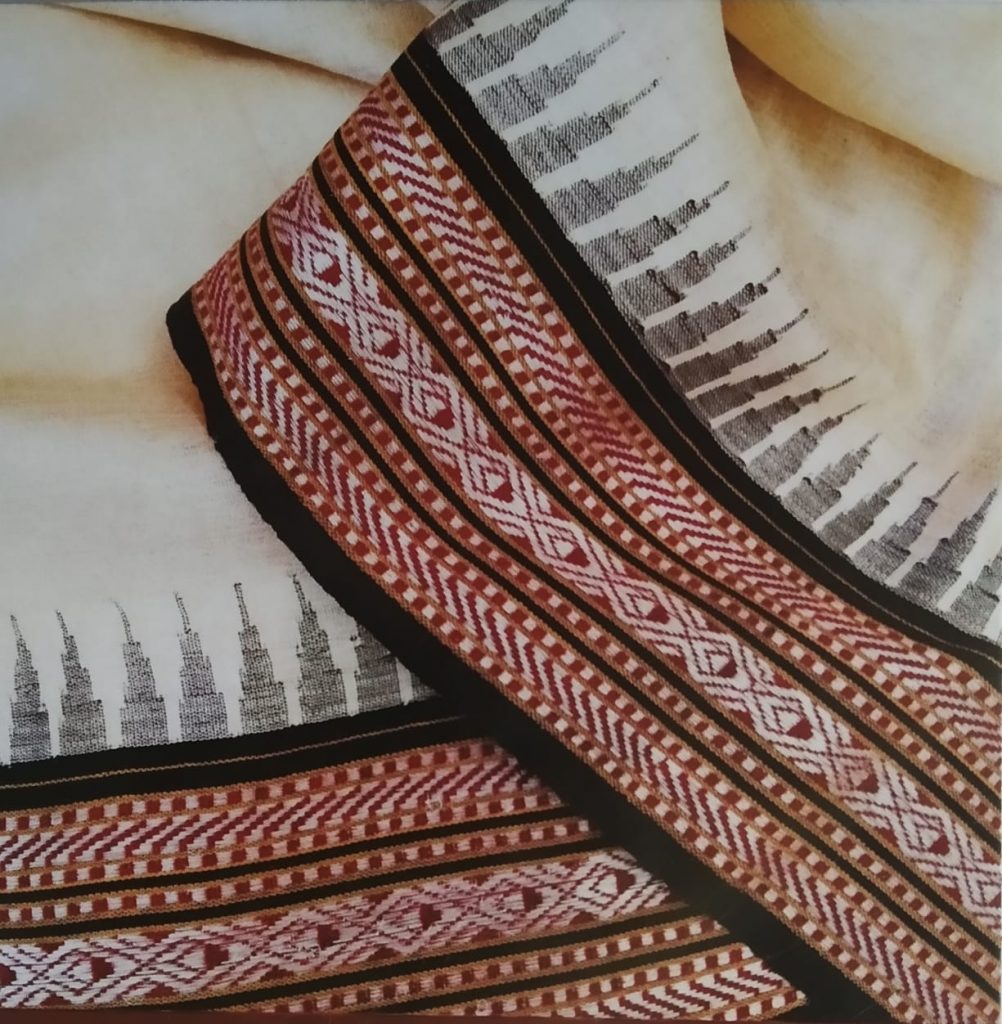
The Karvat Kathi saree is one of the myriad remarkable anecdotes of India’s rich handloom tradition, originating from the culturally vibrant Vidharba region of Maharashtra. Its nomenclature is derived from ‘karvat’ or saw-tooth design that runs along its borders and pallu, i.e., the loose end of the saree. This illustrates the centuries-old artistic fervour of traditional weavers. Crafted from fine cotton or a Tassar-silk cocoon, this saree boasts a soft feel and lightweight drape, making it suitable for both daily wear and special events. This unique style is an auspicious attire for various celebratory cultural occasions like marriage, Diwali, and baby shower celebrations. A defining feature of the Karvat Kathi saree is its detailed and balanced geometric patterns, often drawing inspiration from nature and local customs.
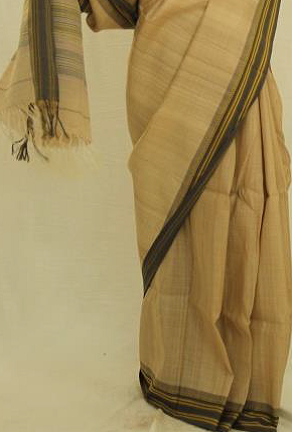
These sarees incorporate features from the renowned sculptures of Ramtek. It is woven and crafted primarily in the Nagpur, Gondia, and Bhandara regions. Karvat Kathi sarees often feature subtle, earthy tones, complemented by vibrant, contrasting borders. Due to a soft renaissance of craft, initiatives and steps have been taken to rejuvenate this traditional saree among the masses and in academia. Akin to every Indian craft-embroidered textile, Karvat Kathi saree transcends fashion and beauty; it resonates with legacies of tradition, artisanal heritage, and cultural sustainability.
A Centuries-Old Tradition
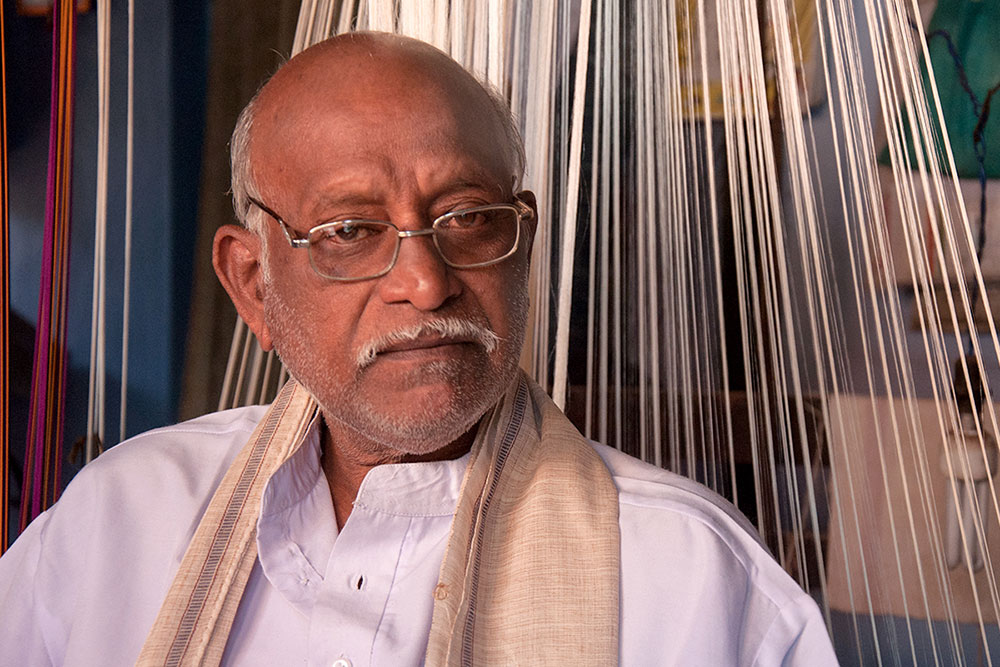
Artisans and craftpersons dominated the Indian textile sector until the onset of imported machine-made commodities from Britain. One of the major hubs of handicraft in the Deccan region was Pauni, a place in Bhandara district. Located on the banks of the Wainganga river, it steadily emerged as a centre of market and trade for the surrounding smaller villages and connects the smaller villages to cities. According to the Bhandara district gazette, during c.1732 C.E., Chand rulers dominated this landscape. In his settlement report, Mr. Lawrence writes how Pauni grew as a result of trade in cotton handlooms.

During the late 19th century, textile materials like cotton fabrics with silk border, Tumsar-ordinary country cloth, Bhagri-Khadi, Beni Carpets & Bedding sheets grew exceedingly popular. As per the 1961 census findings, people started resorting to mill-made cotton due to its affordability and accessibility, which severely hampered silk and cotton local weaving. At Bhandara, the Uparna (shoulder cloth) and Loin cloth were woven. At Mohadi, women’s [Karvat Kathi] sarees and cholis were made. Pauni produced men’s clothes fringed with green silk, and these clothes were rumoured to be the best in the district and most affordable. The task of entrepreneurship development programmes and training the weavers for Tassar reeling was taken up by Development Corporation Vidharbha Limited (DCVL) in 1970-1975.
Making and Crafting of Karvat Kathi
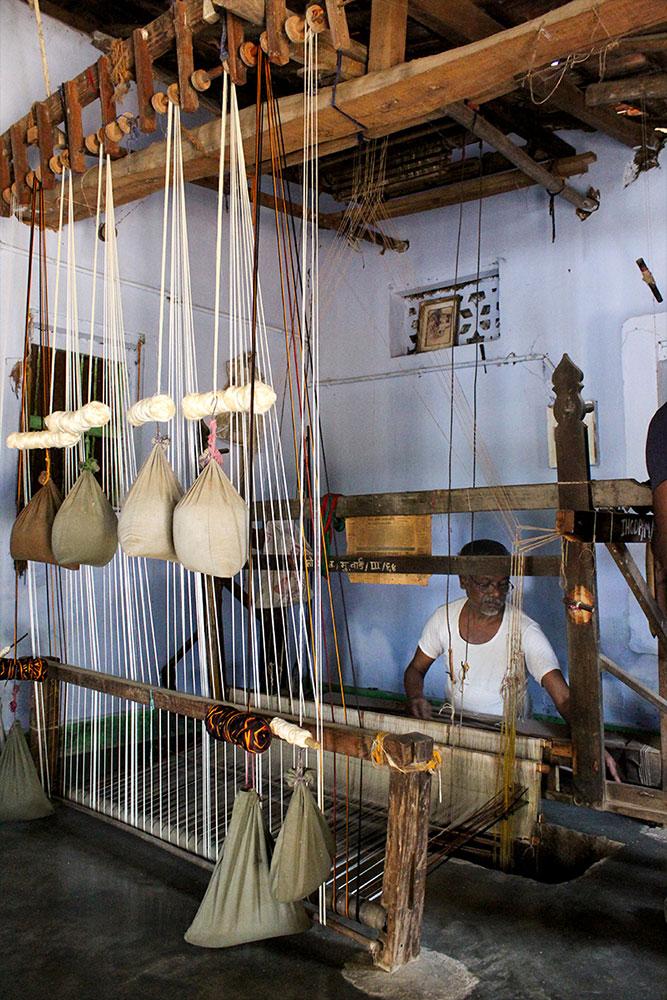
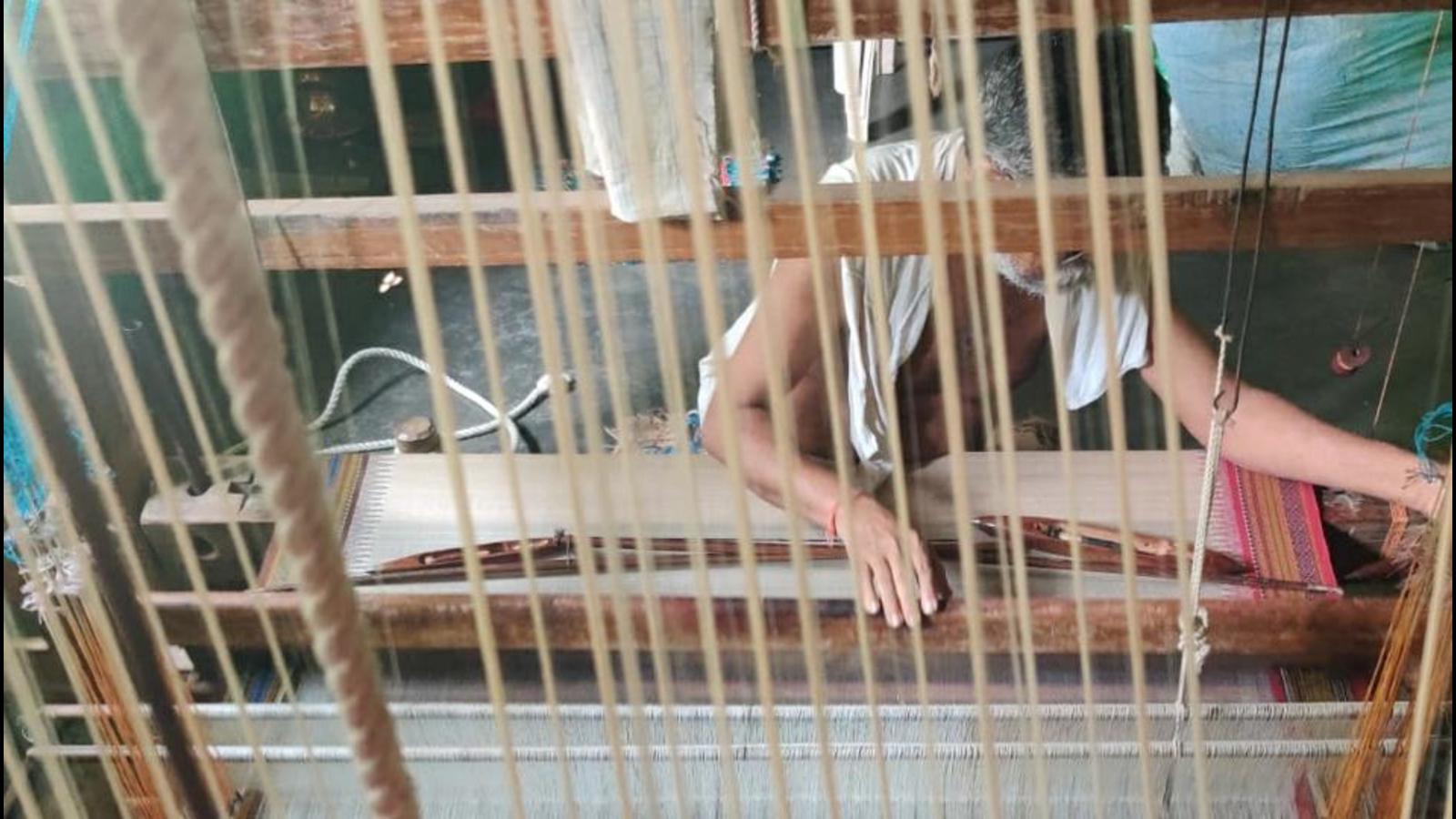
According to Snehal B. Fulare, the Karvat Kathi sarees are woven using primarily the three-shuttle technique. Herein, one shuttle is for the body while the other two are reserved for the saree borders. Karvat Kathi mainly uses five different kinds of yarn – Katia yarn, Ghicha yarn, Balkal/Pedunkal yarn, Jhari yarn, and the Mill Spun yarn variety. These yarns are wound onto a pirn, which serves as the weft yarn for weaving the sarees. Herein, the three-shuttle technique takes place. These pirns are then arranged on a warping machine, a cylindrical metal frame that rotates vertically on a thread roll rack. The length of the warp is determined by the specific saree desired. But usually, a 40-meter warp is formed by rotating the drum around the machine axis.
Today, frame looms are predominantly favoured over traditional pit looms for weaving the Karvat Kathi saree. This modern technology, featuring metal frames, is lighter and more conducive to the craftsman’s comfort and movements. In this three-shuttle weaving technique, the Karvat pattern developed from the borders is achieved by interlocking the weft yarns of the borders with those of the body. This process stems from the artisan’s extensive experience and expertise. Once the borders and body are woven on the loom, the artisan then embellishes the pallu section with manual designs.
Karvat Kathi as a Canvas: Motifs and Niche Designs
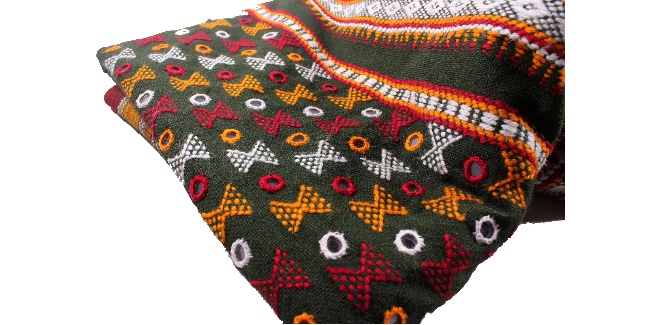
The craftpersons, after seeking inspiration from their ambience, incorporate flora, fauna, and architectural sculptures from the Ramtek temple onto their saree pallus and material. The border of Karvat Kathi is done with dobby, and the motifs on the border are very small in size, distributed in two to three rows separated with clearly distinguishable partition lines of dominant colour yarns. The Karvat pattern, i.e., the saw of a hexagonal blade pattern, is seen adjacent to the borders, towards the body on both sides.

Many of the patterns in the saree borders result from the Dobby mechanism. The distinctiveness of these designs lies in the specific names and descriptions assigned to each element, the combinations of colours used, as well as the dimensions and shapes of the patterns. The local terminology for the Panckha Design is detailed as follows: Doon (the Black Line at the border), Korna (the adjacent Yellow Line to the Black border line), Belkannath (the design), Korna (the adjacent Yellow Line), Panka kinar (the main design), Korna (the adjacent Yellow Line), Bellannath (the design), ornamentation in the Black line, Korna (the adjacent Yellow Line), Half Bugudi (the design), Korna (the adjacent Yellow Line), and Gul, which consists of one yellow and one black line placed next to each other. The local terms for various designs incorporated into the dobby border include: Rui Phool, Karan Phool, Dholak kinar, Jali kinar, Jai Phool, Weet Phool, Bel Kannat, Thikri, Devri, Katari, Lahari.
Challenges and Shortcomings in Present Scenarios
In a survey done by Fulare to check the knowledge and awareness of Karvat Kathi sarees amongst the women of the age group 30 to 40 years, the findings reveal that merely 30% of the respondents are aware of Karvat Kathi sarees. This leads to the inference that the high share of unaware respondents prompts a necessity for awareness campaigns of this art form. In 2017, Karvat Kathi sarees were granted the GI tag for their regionally stupendous nature. Despite this legal protection, we observe that mills and dyeing industries are producing polyester clothes with a Tassar-like glaze that was once exclusive to this fine textile. Vyusti Trust, established by Prachi Saraf of Mumbai, helped more than 80 families of the Koshti community with Tassar silk raw material. The communities were given 90% of the profit share, showcasing how far a collective initiative can take handicraft. According to Prakash, a resident of Gadchiroli, “Life isn’t easy for us. Cocoons are harvested twice a year, once during a period closer to Diwali and then in February. But it all depends on many factors surrounding the place we live in.”
Conclusion: From Ambivalence to Hope
The current modernised and globalised landscape can function to connect these sarees directly to the consumer base, to support artisanal upliftment by adorning gorgeous, historically effervescent sarees. This is why it is important to retain, preserve, and conserve the tradition of Karvat Kathi sarees. These represent a synecdoche, symbolizing a larger reality of supporting these cultural craft traditions.
References:
- Organization for an International Geographical Indications Network – oriGIn. February, 2022. STATEMENT OF CASE FOR BHANDARA TUSSAR SILK
- Fulare, S. B. (2025). Cultural Heritage and Socio-Economic Significance of the Karvat Kathi Saree: A
- Comprehensive Awareness Study. Journal of Research and Development, 94-97
- Baral, B. & Srikanth B. (n.d.). Karvat Kathi Saree Weaving – Nagpur, Maharashtra. D’source. https://dsource.in/sites/default/files/resource/karvat-kathi-saree-weaving-nagpur-maharashtra/downloads/file/52_102_karvat_kathi_saree_weaving_nagpur_maharashtra.pdf
- Karvath Kathi Sari Weaving of Maharashtra – Asia INCH – Encyclopedia of Intangible Cultural Heritage. (n.d.). Asia InCH – Encyclopedia of Intangible Cultural Heritage – Open Educational Resource on the Intangible Cultural Heritage of the Traditional Arts, Crafts and Textiles and Their Practitioners and Transmitters in South Asia. https://asiainch.org/craft/karwath-kathi-saris-of-maharashtra/
- Beyond the fold: The allure of Karvath Kati Sarees | Incredible India. (n.d.). Incredible India. https://www.incredibleindia.gov.in/en/maharashtra/karvath-kati-sarees-and-fabrics
- Sood, M. (2021, October 10). ‘Royal weavers’ of Karvat Kati sarees in Maoist areas of Maharashtra get help | Mumbai news. Hindustan Times. https://www.hindustantimes.com/cities/mumbai-news/royal-weavers-of-karvat-kati-sarees-in-maoist-areas-of-maharashtra-get-help-101633883461307.html