Sonal Butley is a student of History Honours at Hansraj College, University of Delhi. She has a penchant for writing, researching, editing, and proofreading all things History and Culture. She is an aspiring academic.
Send a Message to this Author
0 1103
Share
Introduction
Profile image of Gopal Deuskar from page 288 of the book शिल्पकार चरित्रकोश खंड ६ – दृश्यकला (Source: Wikipedia)
In the annals of the twentieth century, a brushstroke by a profound portraitist changed the trajectory of art remarkably, by interplaying old ideas with the new ones through his canvas. This skilled Maharashtrian artist established his career and identity by making thought-provoking portraits. The prolific artist Gopal Damodar Deuskar wasbornintoaremarkablytalentedartistic family. Deuskar’s grandfather sculpted religious sculptures. Deuskar’s father instructed art at a school of Ahmednagar. He was born during the shiftfrom colonial India to Independent India, with his influences and expressionsbalancing the emergence of modernity and the constraints of pre-modernity.
(Source: Rajendra Vahadane and Amit Khare, Facebook) Portrait by Gopal Deuskar
Deuskar’s talent lay not in loud experimentation or extreme defiance, but in the enduring influence of portrait painting and murals. His brush conveyed order, while his gaze brought forth empathy. Through the faces he depicted—be it those of leaders, visionaries, or common individuals—he encapsulated personality, essence, and heritage. In his art, history transformed from an abstract concept into a living figure meeting your gaze, noble and vibrant.
Roots and Beginnings
Gopal Deuskar lost his parents when he was two yearsold. He went to school in the Nizam region of Hyderabad and finished his primaryeducation up to the Matriculation level. Because his parents had passed away, he was sent to live with his uncle, R.W. Deuskar, who was a well–knownartist, in Hyderabad. In 1927, he joined the Sir J.J. School of Art in Mumbai. Here, he stayed with Bapurav Pendharkar i.e. his brother-in-law, at the Lalit Kala Darsh Natakmandali. He completed his studies in 1931 and graduated with topmarks, winning a goldmedal and otherawards. When Gladstone Solomon, the Chancellor, organized an exhibition in London featuringworks from selectedstudents of the school, Deuskar’s art was included. In 1939, Captain Solomon praised Deuskar’s talent in both Western and Indianartstyles in the Times of India. He predicted that Deuskar would develop a uniquestyle in Indianpainting.
After finishing his studies at the Sir J.J. School of Arts, Deuskar receivedseveralawards for his artwork, including a goldmedal from the Bombay Art Society, the Viceroy medal at the Shimla exhibition, and firstplace in a contestheld by the Indian Railways. He was given a five-yearscholarship by the Nizam of Hyderabad to studyfurther in Europe. He attended the Royal Academy in London and quickly became known as the onlyIndianartist who regularlyshowed his work at Europeanexhibitionsorganized by the Royal Academy. His famouspaintings, ‘Shakuntala’ and ‘A Bull’s Holiday’, were displayed at the Royal Academy in London in 1936 and 1938, respectively. After his achievements, the Nizam extended his scholarshipfurther.
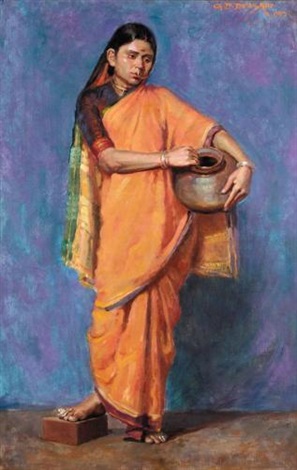
Untitled by Gopal Damodar Deuskar (Source: artnet)
Art that Speaks
Deuskar’s work can be categorised into three bifurcations–subject pictures, ‘normal’ portraits, and ‘Indian-style’ water-colour. The subject pictures can be apprised as paintings of symbolism, composition, and mood often embellished with western techniques and painting traditions. These works are mostly narrative or thematic, not portraits. Among the portraits, the works of Sir Akbar Hydari and Sir V T Krishnamachariar stand out as his most notable accomplishments. These pieces are clearly influenced by Western styles. According to W.E. Gladstone Solomon, Deuskar’s watercolour portrait titled ‘Raja and Rani’ showcases his delicate sensibility towards color and design, drawing from an instinct that is characteristically Indian, rather than relying on ancient or medieval traditions. His Academy artworks reveal that this adaptable young painter is influenced by both Eastern and Western styles. They combine elements of Oriental decoration and poetry with Western techniques and proportions. Each piece showcases Deuskar’s innate talent for pictorial composition and design, which is his greatest strength; thus, it is possible that this talented young artist’s efforts to blend and harmonize key aspects of Western and Eastern art could give rise to a new school of painting.
In Gopal Deuskar’s early art, his narrative through his paintings was straightforward and sound. He showcased work realistic and precise in stance, his portrait figure often in standard balance against the modulated background. His eminent contribution and work in the field of portraiture earned him the distinction of being the only Indian painter with five successive exhibitions in the Royal Academy of Arts, London. Deuskar’s art career began with the outbreak of the Second World War, and for many years, his voyage in the ocean of art was eternal.
Honours beyond Horizons
Painting by Gopal Deuskar (Source: https://www.dainikprabhat.com/painter-gopal-deuskar/)
Gopal Deuskar and his elaborate range of recognition of his art earned him a position as the Deputy Director at his alma mater, that is, Sir J.J. School of Arts. Furthermore, Baroda Palace granted Deuskar the status of a ‘state artist’ and nudged him towards an independent and free-willed journey. He was open to the air of nobility and aristocratic romanticism through his paintings and the remarkable stroke of his brush. Adding layers of depth and dimension to his portraits, Deuskar spent fifteen years in the Baroda Palace. The individual uniqueness of rulers all across India, especially from Baroda to Jaipur, was captured wonderfully by Gopal Deuskar. Even after the royal princely palaces faded away, Deuskar remained in the limelight.
Portrait of an Aristocrat by Gopal Deuskar (Source: Gopal Deuskar Documentary Film by V.K.Wankhede https://www.youtube.com/watch?v=2OvisykOVL4&t=129s)
Following India’s independence, Deuskar’s main patrons included prosperous business figures from various private and governmental entities. In 1955, a parliamentary committee selected Deuskar to create paintings. His creations hung with grandeur on the walls of Sansad Bhavan, Victoria Memorial Museum in kolkata, Rashtrpati Bhavan in Delhi, Vidhan Bhavan inMumbai, the Supreme Court, Mumbai’s high court, business leaders’ private homes, and myriad public structures. He also captured the likenesses of Raja Ram Mohan Roy and Lokmanya Bal Gangadhar Tilak, which are displayed at India House in London, along with portraits of J.R.D. Tata, the Attorney General of India, M.C. Setalvad, authors like Acharya Atre and Chiplunkar, the Governor of the Reserve Bank of India, and notable figures from the Indian Army and Air Force.
Strokes that Endure
Honour by the Maharashtrian State to Gopal Deuskar (Source: Gopal Deuskar Documentary Film by V. K. Wankhade https://www.youtube.com/watch?v=2OvisykOVL4&t=129s)
The eminent portraitist was selected for the Lalit Kala Akademi in 1959 with eight other artists, and worked rigorously. In Fergusson College of Pune, he was offered a residence for his art. Herein, he donated myriad artistic pieces and portraits. Additionally, Deuskar beautifully completed ‘Karmayog’, a remarkable mural for the Tilak Samarak Mandir in Pune. Worried about the ongoing state of art education, the artist has remarked,
Juiley by Gopal Desukar, Oil on Canvas, 63.5 X 51.5 cms (Source: unseenartofindia on Instagram https://www.instagram.com/p/CY9IvVWNr3r/)
“The present education in art contributes nothing to give a solid grounding, that is required most to enter into the profession of an artist. I don’t blame the teachers, neither the students. Today it is more or less a crime to paint academically or realistically.”
Deuskar integrated two divergent yet not necessarily antithetical modes of art together, and created wondrous pieces of art and portraits for a lifetime. From his intricate attention to detail of the attire and jewelry to vivid style and immense hard work, Gopal Deuskar has left a legacy for all the people in and outside the realm of art.
Films Division. (2013, June 17). Gopal Deuskar [Video]. YouTube. https://www.youtube.com/watch?v=2OvisykOVL4
Gladstone, W. E., Solamon. (n.d.). The paintings of Gopal D. Deuskar. https://thekarhaadaa.org/articles/GD_solomon.pdf
Ben Uri Research Unit. (n.d.). https://www.buru.org.uk/contributor/gopal-damodar-deuskar-#:~:text=Gopal%20Damodar%20Deuskar%20artist,Indian%20aesthetics%20with%20Western%20technique.