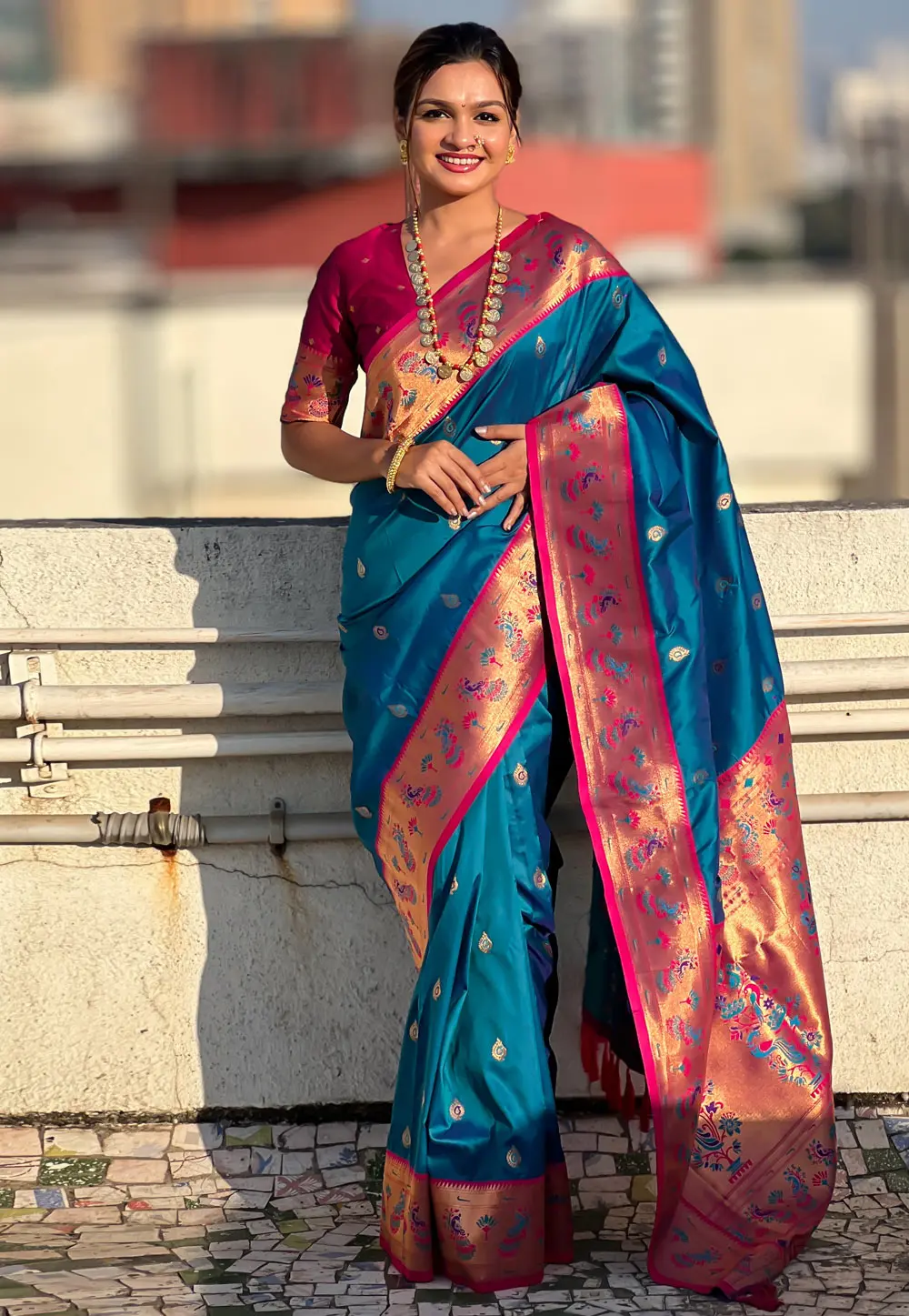
The piece of cloth we wear every day is the piece of Cloth woven by love by someone. Same peace of love is woven by the community in “Paithan” on the banks of the river “Godawari” the city in Maharashtra. The love of handlooms woven in the royal treasure of sarees. Paithani weaving is the old and traditional pattern of the weavers in Maharashtra. Other than just the weaving, these sarees contain a blend of art, culture, heritage and skilled craftsmanship. These sarees are famous for the vibrant colours and naturally inspired designs. These sarees are often worn as the statement piece of royalty and are often worn in rituals and weddings. Paithani is celebrated for its luxurious silk and zari work. Paithani is not a textile its more than that, its artefact that tells about ancient trade relations of India and shows the skilled craftsmanship of Indian artisans.
Source: .indianclothstore.com
Woven Through History
The history of Paithani can be traced back to 2500BCE from the time of the Satavahana dynasty, when the saree used to be made from pure silver and sold in threads. At the time of the Satavahana, the trade in Maharashtra flourished, and the water routes for trade flourished. As the trade flourished, the Paithani sarees from Maharashtra were exported to Rome. The traces of this fabric are found in the Hindu and Buddhist texts. This fabric is also called the”Dev Vastra” {The fabric of god}. The old name of the city paithan was Pratishthan. It was also the capital of the Satavahana. Paithani, in olden days, was known as Pratishthani, as it was only worn by the royals. It came to fame during the Maratha and Peshwa period as the symbol of royalty. The weaving of Paithani flourished under the Vakataka, Chalukyas, Rashtrakutas, Yadavas, Mughals, Peshwas, and Nizam. Some archaeological evidence explain us that Paithan was once a major hub for textiles and fabrics for trade.
Source:playcreatelearn.wordpress.com
Silk, Gold, and Skilled Hands
The weaving technique takes patience and the hardwork of the Maharashtrain weavers.The materials that is ues in weaving is the pure mulberry silk. The “Zari” That is the border of the paithani is made by weaving the pure gold and silver which make if royal. One of the most unique weaving of Paithani sarees is the Tapestry technique. In this technique the motifs are woven directly into the fabric instead of being printed or embroidered later. seperate bobbins are used for each color in the design. this allows the weaver to create sharp and detailed patterns with a reversible pallu. the design looks almost same on both sides. The process of weaving starts with traditionly dying the silk yarn by using the natural colours to make the saree look more vibrent and royal. The colour used for dying are all natural. After the dying is done yarn is strched and weavers work to make the most beautiful part of saree that is (Pallu) Padar. Depending on the complexity of the motifs and zari work, weaving a single Paithani saree can take several months to over a year.
Source: Shopify.com
Motifs That Tell Stories
Source – Sahapedia
Paithani is famous for its motifs, which are often inspired by nature or from a religious context. These motifs are not just a normal pattern; they tell us a story of their own creation. Such as Peacocks and parrots are natural motifs that present as symbols of beauty and grace. More nature-related motifs are Lotus, Flowers and many more, that are present as symbols of fertility and prosperity. Paithani are known for their colour. The traditional colours that are still used to prepare the Paithani saree are Neelgunji, Mor bangdi, Raghu, Pophali and Chandrakala. Modern weavers try to do experiments in which they balance the traditional colour with a modern blend, which feels appealing to customers. One of the outstanding features of the paithani saree is the colour shifting effect from different angle different shade is visible. How does colour shifiting happens. This is possible due to the silk threads, which are woven in an interlocking style.
Weaving communities
The Paithani weaving is a traditional occupation that is passed down from generation to generation. The families that are in this occupation and passing it down are Sali, Koshti, Pavtekar, and Chapade. These families still traditionally make paithani sarees. They look at all the stages. of production spinning, dying, weaving and fishing. In the weaving process, the entire household gets involved. The women of the household used to guide from preparing yarn to motifs. The knowledge of preparing a Paithani saree is never documented; it was just passed down orally and through practice.
Decline and rising period of paithani
Source – Pratishthani
The Britishers came to India, and they introduced industrialisation. Machine-made products are much cheaper compared to the weaving process. High taxes were applied on indian products; as a result, many weavers and artisans were forced to leave their craft. This was a period of the Paithani saree when the production of the Paithani saree was almost dying. But still, royal patronage keeps the demand for Paithani saree, which keeps this tradition alive. Even today, Paithan weavers face many problems, such as the high cost of raw material, High production time, which takes immense time, sometimes months. The competition with the powerloom industry, who are making Paithani Saree through machines. The interest among the youth about Paithani has decreased, as many new type of cloth has came in the market, so it’s not easy for any traditional art to keep up in the market. The Government is taking initiatives to keep alive this tradition. The government has given a geographical indication. Promoting the Paithani saree on the e-commerce platforms to increase the demand. The towns like yeola is emrging as the new weaving centre of Paithani saree.
Conclusion
Paithani saree is a rich Indian cultural heritage,which reflects the excellence and skilled craftsmanship. The weaving history of Paithani starts from the Indian trade routes to today’s modern-day fashion platforms. It’s our responsibility to preserve this tradition and give honour to the artisans.