



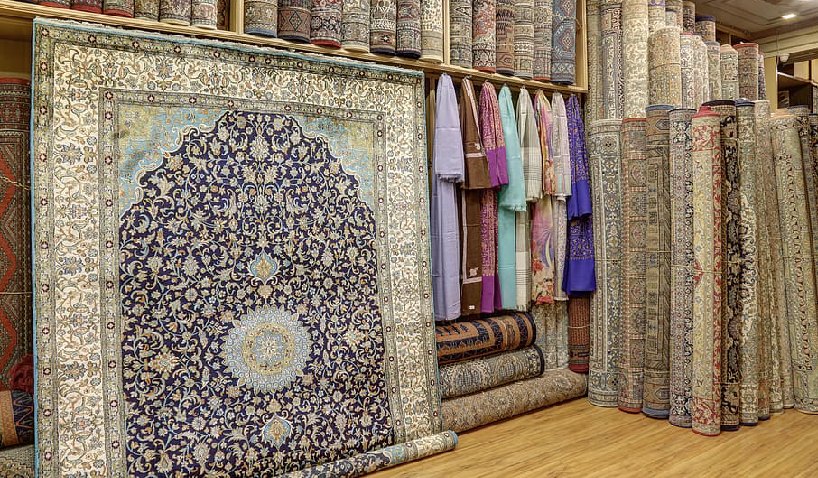
Renowned for its unique, detailed design and weaving technique, the Kashmiri carpet, often known as ‘Kal baffi’or ‘Kaleen’, has a rich and glorious history that dates back to the 15th century. Its intricate design, making process, and quality material make it an allure for the world. People are fond of buying these carpets to bring the majestic aesthetic of the ‘Heaven on Earth’, the Kashmir Valley.
A Journey through Time – Origin and Evolution
The royal sponsorship of Zain-ul-Abedin, also known as Sultan Budshah, who aimed to boost the recognition of Kashmiri carpet weaving internationally, is associated with its rich history. He established a foundation for Kashmiri carpets in the 15th century by inviting weavers from Persia and Central Asia to work in Kashmir.
During the Mughal time, Emperors Akbar and Jahangir improved the weaving process and promoted the heritage of Kashmiri carpets by integrating Persian techniques with regional motifs. This unique combination of local and international skills boosts the expansion of the valley’s art form. This handicraft gained international attention in the 19th century when it was displayed in the London Crystal Palace exhibition in 1851. Art-lovers in Europe were amused by this type of textile production and attracted towards it.

This exhibition showcased the glory of Kashmir on an international level and gained massive attention from the European. In the 1870s, businesses like Mitchell & Company helped revitalise the carpet industry and incorporate Western trends into designs and manufacturing. Government assistance for the Kashmiri carpet in the late 20th century enabled the sector recover from recessions and political instability.

Tales of the Weavers – Signature of the Kashmiri Craftsmanship
These carpets reflect the high knot density manufacturing style and Kashmiri beauty through a unique combination of Persian and indigenous handicraft. This Kashmiri art form is recognised and valued across the world because of its nature-inspired motifs and use of high-quality materials (mostly silk and wool).
Its high knot density, which is mostly 200-900 KPSI (knots per square inch), makes the Kashmiri carpets exceptional. The greater the density of knots is in a textile, the more it is considered durable, luxurious and valuable. Craftsmen mostly used the Persian knoting technique for weaving the carpets, which fabricates tight and detailed patterns and a fine finish on every carpet.

The majority of Kashmiri carpets are made from premium raw materials like Merino wool or Mulberry silk, which add to their softness and gloss. Whereas the mulberry silk is considered the finest and most luxurious type, Merino wool presented premium soft fibre as well as an expensive one. In addition, cotton and staple fibres are used by artisans to increase the material’s longevity. This boosts the gloss finishing of the carpets, which easily attracts the attention of art enthusiasts.

Upon these materials, artisans go through a long process which produces the final result, as it takes several years to finish.
Life, Fertility and Spirituality – Significance of Design and Motifs
Kashmiri carpets are a representation of the valley’s cultural and traditional history, symbolised by fertility, spirituality, and vitality. Each design reflects the beliefs and feelings of the weavers and represents a distinct narrative of the Kashmiri lifestyle, their love for art and craft. Those motifs show Kashmir’s rich culture and heritage, as well as justifying the cultural beliefs, love for nature and spiritualism. Here are a few of them discussed thoroughly.

Zindah Gol or The tree of life – This motif symbolised the growth, eternity and fertility as this is the most iconic motif on the carpets. Featuring a blooming tree in the centre of the carpet, the branches are full of birds, flowers and fruits.

The Paisley Motif or Boteh design – This is an iconic teardrop-shaped motif which resemble to Persian art (Boteh Jegheh) and symbolises prosperity, fertility and life flame. Kashmiri weavers frequently use this design in carpets and shawls.

Lotus Flower – In terms of referring to the idea of purity and rebirth, this pattern represents the mysticism of Kashmiri culture. Loutus motif also defines the purity and enlightenment, whereas in Kashmir, it is known as ‘Pamposh’.

Gulabdar (Rose) – The design of the rose is also one of the popular floral motifs, which signifies the celebration of beauty and peace.

Chinar Tree – The legendary Chinar tree from the Kashmir Valley represents the area’s majestic natural glory, which attracted people for ages. The Chinar leaf motif reflects the beauty and resilience and has become the cultural icon of the valley for ages.

The Kashmiri Carpet Making Process – Manufacturing the Cultural Heritage

These traditional Kashmiri carpets are made through a lengthy, multi-stage procedure.
Naqsh (Creation of Design) – Begins with a designer where the pattern of carpet on graph paper. Each of square on the graph paper refers to a single knot of the carpet.
Talim (The Code) – Designing the carpet is known as Talim, where the motifs are finalised, and colours are chosen. The overall layout of the carpet is also decided during talim, written as carpet language code, which weavers follow.

Purchasing materials and dyeing: After the final pattern and colour are decided upon, the raw materials are dyed and left to dry in the sun. Different colours have distinct meanings. Understanding the different meanings behind the colours are essntial for one to truly know this Kashmiri heritage.
like Black – signifies authority and power
Blue – express exhilation, orange radiates warmth and energy
Red – encourages actions
White – reflects purifications of actions or thoughts.


Weaving – When the yarn was passed to the weavers, he set the loom (‘khaddar’) accordingly and prepared warps and wefts for the carpet. As the Kashmiri carpets are high-knot (200-900 KPIS) and handwoven, there are different types of knots used during the process. As the number of knots directly signifies the value of the carpet, weavers work sincerely in this stage.

There are different types of carpets depending on the weaving materials and knotting process.
Silk on Silk Carpets (S/S): This is a 100% pure silk Kashmiri carpet, where both the warp and weft are made of pure silk thread. This carpet is luxurious and gives a high-end floor covering.
Silk on Cotton Carpets (S/C): In this carpet, cotton contributes to the warp making, while silk has been used in the weft. These types of carpet give a strong foundation for further knotting and are more durable than other ones.
Wool Carpets: These kinds of carpets feature knotted wools, where pure wool is used for the warp and weft process. These types of carpet work as a natural insulator and enhance the quality of indoor air.

Staple Carpet: The synthetic silk used to make this type of Kashmiri carpet is not pure silk. This is often budget-friendly and accessible for people to decorate their households.
Finishing – After the weaving is complete, the carpet is taken off the loom and chemically cleaned to enhance its colour and gloss. A machine is used to polish and bind the edges.
Understanding the beauty and relevance – Cultural and Economic impacts
Kashmiri carpets reflect the mesmerising beauty and authenticity of the valley, where they bring economic goodwill to the locals. There are numerous cultural and economic significance which embodies the region’s legacy of traditional art forms that have been passed through generations.
Heritage preservation – The carpets represent the rich history of Kashmir and reflect the connections of Persia and Central Asia.
Skill transfer – The weaving tradition is cherished through the carpet making, where the artistic expression in motif designing reflects the local flora.
Increment of employment – As a complete labour-based industry, carpet weaving provides approx 400,000 people across Jammu and Kashmir. IICT organised different skill upgrade schemes for the carpet weavers, where 11,000 people were trained and get stipend (kashmirobserver, 2025).

Relevance – These days, Kashmiri carpets are quite significant as their legacy is depicted in several films and documentaries across India and at the global level.

Conclusion
The world is charmed by Kashmiri carpets, which not only cover the floors but also speak to the heart of the Kashmiri heritage. Since the 15th century, carpet-making has showcased the rich history and cultural nuances that have generated a major way to earn for Kashmiris. Understanding the reconnecting with this historically enriched artform embrace the knowledge about cultural heritage. Thus, this article highlights some major facts about the legendary Kashmiri carpets.
References
- https://www.kashmirmart.com/kashmiri-carpets-handwoven-heritage-for-your-home/
- https://newlinesmag.com/reportage/the-unraveling-of-kashmirs-handmade-carpet-industry/
- https://www.yakcarpet.in/blog/buy-authentic-pure-silk-kashmir-carpet-rug/?srsltid=AfmBOoq9fc3pMXMszQU3PQrJtulQzKzLEEpU_vVa0WKg-_xkJVXMviIR
- https://carpetsofkashmir.com/colour-and-symbol
- https://www.gyawun.com/product/shaan-e-kashmir-tree-of-life-kashmiri-handmade-chainstitch-wall-hanging-3x2ft/?srsltid=AfmBOop8qyTaGO9l1hqnOxB7zSEmwzQ-Oizum-BdI0EQyonyjXczVNNo
- https://nazmiyalantiquerugs.com/boteh-paisley-pattern-rugs
- https://www.kashmirbox.com/products/online-store-for-kashmiri-hand-embroidered-lotus-rugs-and-namdas-craft-kashmir-box?srsltid=AfmBOoqdKvHaR8a2RtDhP-Wt6p3KxSkcUR8bhFIOPzHbfwhDJMMfktAq
- https://kashmirbox.wordpress.com/2015/10/13/the-carpets-of-kashmir
- https://www.gyawun.com/product/6×4-chinar-leaf-handmade-aari-embroidered-wool-namda/?srsltid=AfmBOormSdvaZ6Ij2azFj2AMQGpt8vxlB3TKXh2gH2mNnr17dlzYn55t
- https://sputniknews.in/20221213/talim-the-encrypted-language-only-kashmiri-carpet-weavers-understand-16654.html
- https://urbanaut.app/spot/the-dying-art-of-kashmiri-carpet-and-pashmina-weaving?srsltid=AfmBOoomihAclOut-LdGN_PUA8qKhX4xKfOU3aYYoe5ssOWJYveq8LPN
- https://www.architecturaldigest.in/story/a-book-on-kashmiri-carpets-reveals-the-complex-histories-of-the-crafts
- https://kashmirobserver.net/2025/07/11/iict-upgrades-skill-of-11000-carpet-weavers-under-various-flagship-schemes/
- https://economictimes.indiatimes.com/industry/cons-products/garments-/-textiles/unknotting-kashmirs-carpet-woes-hand-knotted-kashmiri-silk-carpets-called-kal-baffi-are-making-a-subtle-yet-striking-comeback/articleshow/120439889.cms?from=mdr